Learning about Startup Investing

How are startups raising the seed funding they need to get to the next phase?  This is a very simple overview of a few vehicles that help startups raise capital and some new and interesting trends in the ecosystem.

Syndicates
An Angel or Fund can lead a Syndicate on AngelList. Investors that are backing the Syndicate have the option to invest in specific deals that are being syndicating. Syndication allows Investors to pool their resources and share risks.
Ex: FG Angels

Funds
Funds on AngelList are “index funds” or “fund of funds” that give Investors broad exposure to lots of deals within a specific vertical. An Investment committee votes on deals that have been syndicated.
Ex: AngelList Consumer Fund

Corporate Investment in Super Angels
Recently, Mailchimp invested $2M into Sig Mosley’s $30M super angel fund.  Thriving companies like Mailchimp see this type of investing as a way to diversify cash, help startups and get early access to the most innovative companies in their space.

Accelerators
Many startups choose to go through an Accelerator program. Typically an Accelerator program will take an equity stake in the startup and provide seed capital and a convertible note option, a loan that converts into equity at some point in time.
Ex: Techstars provides $118k for a 7-10% equity stake

Angel Investors
Individual Angels are a core part of the ecosystem. Startups will often bring on several Angel investments in combination with going into an Accelerator or using AngelList to assemble the seed capital they need.

Crowdfunding
Hardware and hard goods startups are using a combination of Angel investing to get the company running with a prototype built and Kickstarter to fund the first product release.  Ex: Ubooly

I recommend reading Venture Deals by Brad Feld and Jason Mendelson to get schooled on VC investing.

My Last Day At PivotDesk

David and I have decided that it’s time I leave PivotDesk.  This has been the hardest choice of my professional life.

I wrote the team at PivotDesk a few days ago and stopped by the office to wish everyone well.   We have made commerical real estate more efficient and cost effective for everyone from entrepreneurs to small business owners to brokers and I’m extremely proud of that.

Hopefully this post helps others avoid a similar situation in their companies and gives some context on how this can happen to the best of teams.  As several mentors and incredible friends have told me, this is way more common than people realize.

Alright (sigh), now that’s out of the way so let’s talk about what the hell happened.

Over the past six months I gradually lost the confidence of my teammates.

Here’s how it happened.

Tunnel Vision
For the past three years I’ve woken up in the morning thinking about how to grow PivotDesk and fallen asleep almost every night thinking about what else I should have done that day.  At the park with my kids I was always reviewing my task list, on the weekends I’d crave time alone so I could think about what’s coming up, everything was about growth, scale, more.

I was so caught up in this type of thinking for so long that I had blinded myself to all of the other things that make a team truly work well together.  As all teams do, we’ve had a few disagreements over a variety of situations.  I handled these situations with little care, love or respect for my teammates.  I just wanted it over so we could go back to growth, scale, more.  Little did I realize, I was slowly eroding the support from my team that is needed to succeed together.  And worse, I was growing defensive and outwardly frustrated as my stress level rose.

Stuggling With Co-founder Balance
I began as VPE at PivotDesk and after our MVP and Engineering team took shape moved to VP of Product where I’ve been for the past two years.  I also have a second job as Co-founder.  This job has no job description or performance metrics, rather it’s a mix of a zillion different things from sales to ops to bizdev to customer support.  Finding the balance between these two roles has not been easy and is another reason I ultimately lost the team’s support.

Just a few examples:

  • Taking coffee meetings instead of attending daily standup.
  • Running the company meeting instead of focusing on a great product update during that company meeting.
  • Letting my week fill up with sales, finance, pr and exec team meetings and not leaving myself enough time for deep product focus.

As I asked others on my team for feedback once I realized things were going sideways I heard things like “No one really knows what you do anymore.”

Making the Hard Decision
Saying “hard decision” doesn’t even come close.  When David and I talked about the possibility of me leaving I started visibly shaking, my mouth turned dry and I started having trouble breathing.  As the words “If I’m getting in the way at all, we should seriously consider that I unhook from PivotDesk” came out of my mouth it was surreal.  All of the emotions started kicking in; the Imposter syndrome, anger, disbelief.  We decided to give it a week, talk to the people that have seen this the most, then regroup and make a decision.  For a week I let all of the “Co-founder projects” slip and focused only on product.  I felt like our team was in perfect harmony and kicking ass.  We released a major feature and were collaborating perfectly on the next feature.   Our OKRs were lining up to our analytics informing what we were building and planning on our roadmap.  Ironically, it was one of my favorite weeks of work ever in my career.

At the end of the week David and I spoke again, there was no change in the team’s support, it was time to unhook.  I was crushed.

When talking with a good friend and mentor of mine this week he said “You are not special!”  As I laughed and said, “Hey, thanks a lot.  Is that supposed to make me feel better.”  He said yes and went on to talk about seeing this happen in different ways over and over in fast growing startups.  The company changes so fast and sometimes people and teams simply aren’t the right fit for the phase of the business anymore.  This did make me feel better and he encouraged me to not assume 100% of the burden.

The Next Chapter
It’s incredible how much of one’s identity can get wrapped up in the company they are trying to build.  The constant pitching, the t-shirt wardrobe peppered with company logos and talking about the business at every holiday, lunch with friends or phone call with Mom really adds up.  It’s what you live and breathe as a startup founder and I wouldn’t have had it any other way.

For me, one thing has always stayed constant over the past 20 years of my professional life whether working at a big company or startup, the love of building software.  From the first 10 years as a software engineer through today as a product guy, day-dreaming about cool ideas and turning them into reality is thrilling.  I still get nervous as a I watch customers, friends and teammates use the products I’ve help build.

I don’t know exactly how the next chapter reads, but I’m positive using PivotDesk to share office space will be a part of the mix.


5 Evernote Hacks PivotDesk Uses To Do More Faster

On the eve of an awesome day 1 of #EC2014 I wanted to summarize a few Evernote hacks our team uses to work smarter and do more faster.

1. Use a @today tag
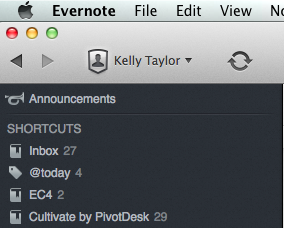
I forget where I read about this but it definitely wasn’t my idea.  Tag notes as @today and add a @today tag search to your shortcuts.  At the end of each day, think about what you are doing the next day and tag relevant notes with @today.  The next day you are ready to rock.


2. Use an Inbox notebook
I have a notebook called “Inbox”.  The web clipper and email forwarding default to that notebook and sometimes when I’m in a hurry I create new notes in Inbox.  Every few days I “process” the Inbox notebook just like I do with my physical inbox and Things inbox.  It also lives under shortcuts so it’s always top of mind.

3. Use Evernote for Company meetings
I heard this tip from Phil on a podcast long ago.  Every two weeks PivotDesk has an all-hands company meeting and multiple people update the company on parts of the business.  Funnel analysis, KPIs, Customer Stories and a CEO update are all components of this meeting.  I have a stack called “Company Meetings” and a notebook for each meeting.  I invite contributors to the notebook in advance then publish it to the rest of the company the morning of the meeting.  We typically have 5 -7 people attending remotely and the rest jammed in our conference room.  We use Google Hangouts so everyone can see each other and then use presentation mode in the conference room as we talk through the data.

4. Use Evernote for Board meetings
In the past, as we prepared for an upcoming Board meeting we would discuss good and bad things in the business that had happened in the past few months and look forward a few months.  We had a lingering feeling that we were forgotting to tell a fun customer story or leaving something out.  Now, with Evernote, we create a new notebook immediatelly following a Board meeting that we use to capture data points, customer stories, articles and anything else relevant to preparing for the next Board meeting.  This has eliminated the need for a long conversation to discuss what happened in the previous quarter because it’s already captured.  This has been a huge time saver for our Exec team.

5. Use a shared Travel notebook for business development
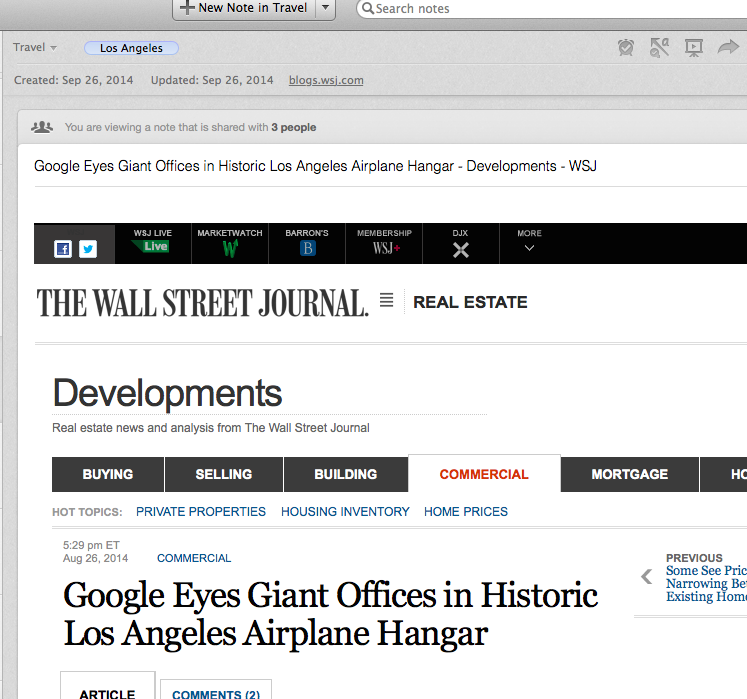
Our team is constantly meeting with customers, partners and prospects around the country.  As a 20 person company, each of us is very well networked in different ways.  We have a “Travel” notebook that we share, each note is tagged with a city.  If our CEO has a trip to LA in the next few weeks, we will clip LinkedIn profiles, articles and add notes about people to meet with, upcoming events and news in that city.  Our CEO is able to leverage the reach and insights from everyone’s network to plan a productive trip.

About PivotDesk
PivotDesk is an online marketplace that connects companies with excess and unused office space to startups and small businesses that need flexible, month-to-month space to grow their business.

What I Want To See From The David Allen Company In 2015

I am such a damn fanboy. The #selfie I took with Phil Libin from Evernote at Collision Conf was something I talked about for weeks and the time I ran into Joe Gebbie outside Om Malik’s Design Conf and updated him on PivotDesk was a highlight for me, not sure why. Actually, I do know, these guys have executed on big things that impact my daily life and I admire that.

So of course, because I’ve embraced GTD and experienced the benefits over the years, I’ve become a fanboy of the whole crew, David Allen, Kelly Forrester, Mike Williams and the David Allen Co coaches I’ve interacted with.

But what happens when a fanboy feels let down?

GTD and it’s principals are rock solid in my view. I’ve lived, taught colleagues and survived by some of the concepts in GTD and can never look back. However, the community around GTD is weakening.

Given a system for GTD, or in general just doing a better job at executing on your day-to-day tasks, why care about a “community”? When I started going deeper and deeper into GTD I found myself leaning on gtdconnect and podcasts for inspiration. I realize this sounds lame but I did it and it yielded results.

Ex: During the past 2 yrs…. 1) I had two little kids 2) got my MBA and 3) co-founded a tech startup. I sought comfort in listening to the same podcasts over and over. Something about the iteration, background noise and community felt like a massive advantage I had in my corner.  Do More Faster, Get Things Done, Inbox Zero were things I enjoyed and made me happy….along with producing good results at work and home.

As GTD Connect has faded, Kelly Forrester has moved on and the whole thing seems weak, I still occasionally listen to old podcasts but am now rethinking my approach. I don’t want to move on but maybe I need to.

Ideas

Here are some things to do.

1. Lots of interviews with people in different domains – the interviews with GTD’ers doing amazing things throughout the world are fascinating and keep me paying my monthly fee.

2. More presence. My company PivotDesk is based in Boulder, CO, one of the most vibrant business and tech scenes in the world. If you asked 100 people on the street about GTD maybe 1 would know, this sucks. Why aren’t there more ways to scale the GTD philosophy in a way driven by the David Allen Co? I would help.

3. Better Software. I use Things. My buddy that has no clue about GTD but crushes it uses Wunderlist. My other buddy I’m educating about GTD uses Asana. The smartest engineers on our team at PivotDesk use only PivotalTracker and nothing else to manage their own personal life. I totally get the “tool agnostic” thing but I’m bummed that David Allen Co hasn’t done more with thought leadership around software to support GTD. I’ve reached out a few times to Intentional Software to beta test some of their rumored projects and have gotten zero response. That’s incrediblely lame and a good signal whatever they’re working on will probably suck. I have no financial gain or career gain, I just want to help and got a goose egg…boo!

4. Meetups. A women in Denver has planned a GTD event in which 3 people show up each month. She is trying so hard to make this work and it’s nice/lame. Where is the support from David Allen Co? These people are your evangalists and they have no support/training/kuddos. They are passionate about what you are selling and you are absent. Embrace this crew of people.

I will continue to be a fanboy in 2014. What David has done is amazing and the dude is great. I evangalize GTD, teach people about it, and use the approach every single day. It’s been a life changer.

However, as I look to 2015 I bet I evolve. Continue to pay $48/month for GTD Connect, no. Buy David’s revision, of course. Tell others about GTD, of course. Be a fanboy, probably not.

Mike – keep GTD Connect an exclusive, amazing resource that’s worth paying for and give the GTD amplifiers a voice. Let me know how I can help.

When will it be done?

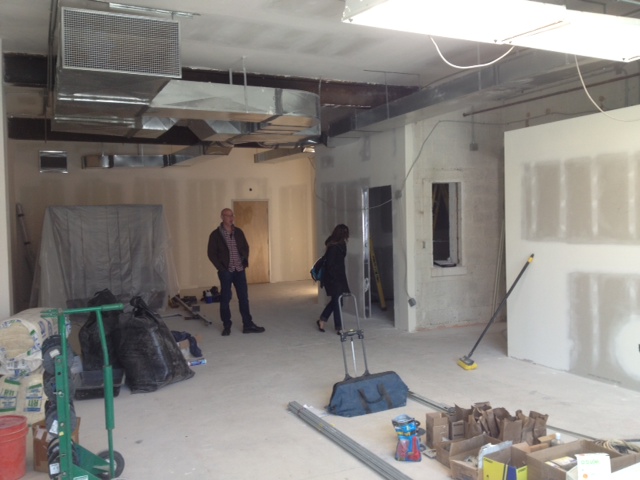
The physical world has a funny way of revealing insights into the digital world. Earlier in the day the PivotDesk Engineering team demoed a new feature that’s “almost done”. As I walked through our “almost done” new office without Internet, a floor or paint on the walls I didn’t really think things were almost done. It reminded me how varying the definition of done can be and how important it is to define that for any project.

office

We use a MVP approach at PivotDesk and I believe in iterating to make things better and better over time. Walking through our office had me thinking about how much effort should go into projects and when. For example, if our office had an Internet connection we could move in, sit on the dusty floor and start working. We would be in the environment and give real-time feedback like “this office would be better if we had desks and chairs”. On one hand this is true early feedback that should be useful, on the other hand it’s completely ridiculous.

How much effort should you put into the first version of a feature you are building? If a little more effort, polish, investment was made, how would your user feedback change? If the feature was a bit more stable, how much extra time and reduced costs would that provide to the project?

I am confident our office is going to “launch” on time and on budget just as features of the PivotDesk platform do. The trick is finding the optimal time to let the “users” in the front-door.

The Mailbox App is a Great Tool for GTD

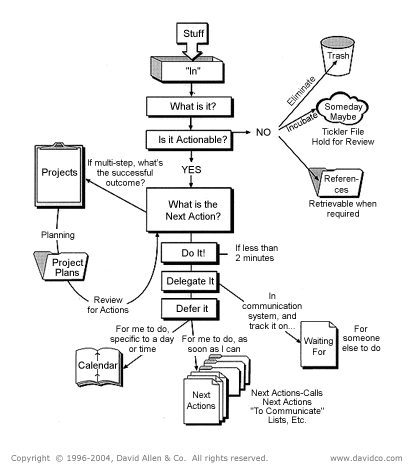
I strive for Inbox Zero but am usually not there. I totally buy into David Allen’s GTD philosophy of “Mind Like Water”.  An empty, processed inbox in which all next actions have been delegated, deferred to my projects list or simply done immediately (if < 2 min) is where I prefer to keep my head.  In that state, I make better decisions about what to work on and can focus on “doing”.

The new Mailbox app enhances the processing phase of the GTD workflow.  As you wake up to an inbox with 50 or so new emails as I do each day, Mailbox makes it very easy to archive, delay until later or reply.

20070206-gtd-workflow

The interesting part for me is the delay feature.  You have to make a decision on every email you read and delay empowers you to control the context in which you want to deal with that email.  Yesterday I received an email from a Vendor that had several contracts attached and was a page long.  This type of email nags at me on some level if it sits in my inbox so I touched “delay until later” which will hide the email and show it again in 3 hours.  In 3 hours I knew I’d be at work, most likely in front of my big monitor with headphones on ready to tackle an email like that which needs to be broken down into multiple actions, docs may need to be printed out, etc.  This clarity enabled me to plow through other emails whereas with Apple Mail or other email clients these emails tended to pile up until I was a bit overwhelmed and put off by my inbox.

snoozes-shot

I hope you find some GTD power in Mailbox as I have. There’s a waiting list and it took me two weeks to actually get access to the app from initial download.


The Energy of an Office

Spending the summer of 2012 surrounded by 11 other amazing companies in Techstars Boulder meant constantly bouncing software development ideas of one another, talking markets and strategy and bonding over financing discussions, mentor meetings and late night weekly Techstars meetings. All of these interactions and activities can be summarized as the Energy of an Office.

After Techstars Boulder Summer 2012 ended, several teams stayed in the office to continue growing their businesses, PivotDesk is one of them. I am never the first one to the office, the lights are always on, there’s always buzz, phone calls, meetings and random important people that I don’t know walking around. I have thrived off this energy in just the few short weeks since Demo Day. Being around other smart people, saying hello around the water cooler, random chit chat about cycling, skiing and software….these things are important. The Energy of an Office, much like the ambiance of a restaurant, cannot be quantified but should always be appreciated.

Find a great home for your business, for now. Visit PivotDesk to find Office Space for Startups with great energy.

Great Jason Calacanis Riff About Boulder, CO

In an interview with Kindara, a Boulder based startup that helps Women monitor fertility, Jason Calacanis discussed Boulder’s business culture.

“The thing about Boulder is everybody is so damn smart and fit and active and intelligent and friendly, it’s absolutely disgusting as a New Yorker but God, you go there and people are like How Can I Help You and Let’s Have An Interesting Conversation and I’m well read and I’m fit and let’s go for a mountain bike ride and talk about the NY Times I just read cover to cover.”

I love this rant.  With Techstars Demo Day a week away, it’s a good time to reflect on the unique ecosystems like Boulder. The Work-Life Balance, Entrepreneurial Density and Exciting Tech Scene make the days fly by and my personal productivity much higher.  Techstars is a prime example of the support a Community can provide, this summer has truly been inspiring.  I’m just happy to be a part of it all.  Thanks for the kind words @Jason…and if you’re wondering, Yes I had Tofu today, read the NY Times and am running a 1/2 Ironman on Sunday to clear my head before Demo Day Aug 9th  😉

Discussion of Boulder, CO starts around Minute 20 of this interview.

The Definition of “Going Live”

Today, Brad Feld walked into my office (well, the Techstars office) and yelled “Time to spin up more dynos PivotDesk!”  5 minutes earlier he and Jason Mendelson had tweeted about PivotDesk which drove 50 concurrent users to our Beta site looking for flexible office space in Boulder.

Our site caved, I added more dynos and restarted all processes and we were back (Thanks Ryan Cook).  The dumbest 10 minutes of my summer at Techstars Boulder thus far.

2012-07-25T22:45:23+00:00 app[web.1]: Started GET "/" for 174.29.90.125 at 2012-07-25 22:45:23 +0000
2012-07-25T22:45:23+00:00 heroku[router]: Error H12 (Request timeout) -> GET beta.pivotdesk.com/assets/layout/denver-img.png dyno=web.1 queue= wait= service=30000ms status=503 bytes=0

“Going Live” is a tricky thing in the enterprise and in Startups.  Leading a large team for the past 2 years at a global enterprise software company, “Going Live” was always about when we felt comfortable telling the disjointed Marketing department that they could make banners for conferences and write whitepapers to put on the website.  I heard “When will it be ready” thousands of times.  “Being Live” meant a 100% bug free, feature complete product that everyone thought was perfect.  Of course this was not realistic and we struggled constantly to come to a shared understanding across the company about this.

In a Startup, “Going Live” means people start tweeting about you.

Here are 2 lessons I reflected on today during my long run up Boulder Canyon to cool down after my fuckup:

1. The day you turn off some kind of basic auth is the day you should increase your infrastructure.

I was kicking back listening to Jeff Clavier drop knowledge on the Techstars teams when my phone started buzzing and the New Relic alerts started arriving.  I had no expectation of increased traffic today and we had not had a single infrastructure hiccup in 60 days since deploying to production for the first time.  My mistake was not thinking of the site as live even though it absolutely was.

2. “Being Live” is not the same thing as MVP, Alpha, Beta, Prototype

You’ve probably heard the question “Are you live?” and the response “Yes, live with a MVP” or “Yes, live with an Alpha”.  That’s all well and good.  Getting feedback fast, not being afraid to put things out there and iterating quickly are wonderful things for software development.  Powering those early versions with weak infrastructure is not acceptable.  Although I had all of the right stuff in place (monitoring, backups, analytics, ability to scale), I was not ready for today’s traffic increase.

So, learn from me and don’t let this happen to you.

Find flexible, scalable office space for your High Growth Business in Boulder and Denver right now with PivotDesk

10 People that Influenced my Career in 2010

This is the most procrastinated post I’ve had, but wanted to put it out there anyway.

____________________________

As a great year comes to a close, it’s fun to reflect on people that impacted you in some way, here’s my top 10 list in no particular order.

Mark Suster

I found out about Mark when he began hosting TWIV.  This is now my favorite podcast, I watch it either on the plane or in my basement on the Apple TV.  Mark’s knowledge, attitude and passion for his industry is inspiring and motivating.  Thanks Mark.

Brad Feld

Ever since I met Brad he’s been a huge source of motivation to me.  The type of motivation Brad brings is unique, it’s practical motivation.  I have learned more tactics (Morning Think, Life Dinner, Do More Faster) from him than anyone else thus far in my career.  Thanks Brad.

Ninan Chako

Since our company was acquired a year ago I’ve been on a ridiculously fun ride.  Ninan, the CEO of PR Newswire, asks questions constantly, loves what he does and generates energy whenever he comes to Denver.  I am having a great time working for and learning from you Ninan, thanks.

Mark Solon

I met Mark somehow this year via Twitter and can’t think of anyone I barely know that I have more in common with: tech, skiing, biking, investing, family.  Mark’s story is awesome and his career situation is one I’m striving towards.  Thanks Mark.

Rob Johnson

The project my team began this year involves big data and semantic goodness.  I had talked with Rob face to face once before during the 2009 Triple Bypass bike ride around 11k ft at the base of Loveland Pass.  This year I have talked with Rob and the GNIP team weekly getting a full blown education in API terms of service, rate limits and the activity format which has been crucial to our success.  Thanks Rob (and Jud and Chris).

Dan Primack

I signed up for Dan Primack’s daily email this year (thanks Mark Solon) and have felt more in touch with the PE and Venture Capital industry than ever before.  It is the most informative email I get every day, easily trumping any NY Times or WSJ email updates, etc.  Thanks Dan.

Vivek Wadhwa

I have never met Vivek and have only seen him speak once, at the Defrag Conference this November in Denver.  I talk to people almost daily and cite points from Vivek’s talk about creating innovation culture.  Thanks Vivek.

Howard Lindzon

2010 began by dialing into an 8am skype call with Howard on New Years Day, Jan 1st.  I was surprised when he suggested that time but then realized this is how people that are motivated, successful and driven role.  Time, place, space….these things do not matter to people like Howard.  Thanks for starting my year off right Howard.

Jason Keller

Jason was a co-founder of The Fuel Team, acquired by PR Newswire in 2009, and ran global products for PR Newswire for a year.  We have been working side by side for 8 years but this year was especially fun.  Jason’s work ethic, personal organization, family focus and drive is a huge motivator for me.  Thanks Jason.

David Allen

I’m not sure how I learned about David Allen’s Getting Things Done but it has absolutely had one of the most positive impacts on my work and personal life than anything else in the past few years.  I have his podcasts, specifically the Guided GTD Mind Sweep episode, at the ready.  I use Things for the Mac throughout the day and have used many of David’s ideas to optimize my personal and professional life.  Thanks David.

Lists are a funny thing.  If I had titled this “the top 20…” then I would have written about amazing people like Micha Hanson, Elliot Turner, Keith Hunniford, Chad Fowler, Fernand Galiana, Paul Kedrosky, and Rod Nicolson.  As I finally post this in 2012, it’s fun to see who I’m still working with, who is still a big influence and who has faded from my life.